Rhythmic Wave Intelligence
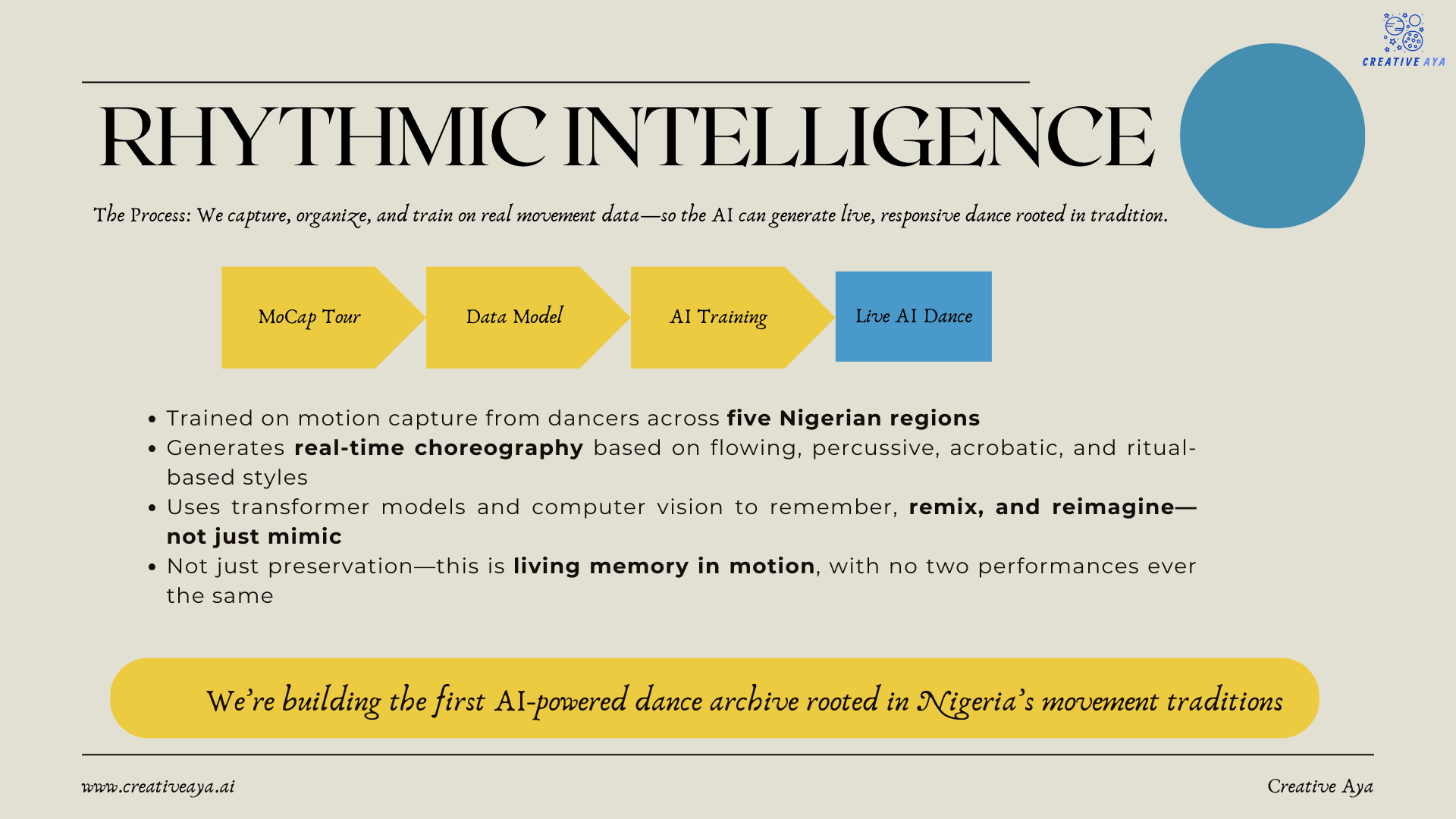
Rhythmic Intelligence AI Choreography Model
This Lab outlines how Rhythmic Wave II is approaching the design of an AI choreography system as a cultural and collaborative process. Rather than training on abstract movement data alone, the model is being developed through direct engagement with dance communities in Nigeria to define movement lineages, regional contexts, and boundaries around what is sacred, contextual, or open to reinterpretation. The system is grounded in techno vernacular creativity, where remix functions as a mode of continuity rather than extraction. By structuring motion capture, cultural annotation, and model training together, the project explores how AI can support living, negotiated forms of cultural memory, producing real time choreography that is responsive, situated, and intentionally non repetitive.
Core Design Areas
Community Defined Movement Knowledge
Dance styles, origins, and meanings are defined collaboratively with practitioners, not inferred solely from data. This includes identifying which movements can be transformed and which must remain protected or context bound.
Motion Capture as Cultural Record
Movement is captured from dancers across multiple Nigerian regions, preserving not only form but rhythm, timing, and stylistic nuance. The archive functions as a living reference rather than a static repository.
Structured Remix through Techno Vernacular Creativity
Drawing from Nettrice Gaskins’ framework, remix is treated as an intentional, authored process that respects lineage while allowing recombination across styles without flattening difference.
AI Training as Interpretive Process
Machine learning models are trained to generate choreography that responds to live inputs and performance context, prioritizing variation, flow, and responsiveness over replication.
Live Non Deterministic Performance
The resulting system generates choreography in real time, ensuring that no two performances are identical. Each output reflects an ongoing negotiation between tradition, technology, and present conditions.

